
Artigo Original
EVALUATION OF RADIOLOGICAL VIRTOPSY AS A SUBSTITUTION METHOD FOR TRADITIONAL NECROPSIS IN CASES OF DEATH BY TRANSFIXING WOUND IN THE CRANIAL REGION, DUE TO PUNCHING ACTION (FIREGUN PROJECTILE)
How to cite: Chambriard CJ, Souza SALD, Menegassi ZJB. EVALUATION OF RADIOLOGICAL VIRTOPSY AS A SUBSTITUTION METHOD FOR TRADITIONAL NECROPSIS IN CASES OF DEATH BY TRANSFIXING WOUND IN THE CRANIAL REGION, DUE TO PUNCHING ACTION (FIREGUN PROJECTILE). Persp Med Legal Pericia Med. Vol. 11, 2026; 260428.
https://dx.doi.org/10.47005/260428
Submitted on 26/04/2026
Accepted at 29/04/2026
The authors report no conflict of interest.
EVALUATION OF RADIOLOGICAL VIRTOPSY AS A SUBSTITUTION METHOD FOR TRADITIONAL NECROPSIS IN CASES OF DEATH BY TRANSFIXING WOUND IN THE CRANIAL REGION, DUE TO PUNCHING ACTION (FIREGUN PROJECTILE)
Abstract
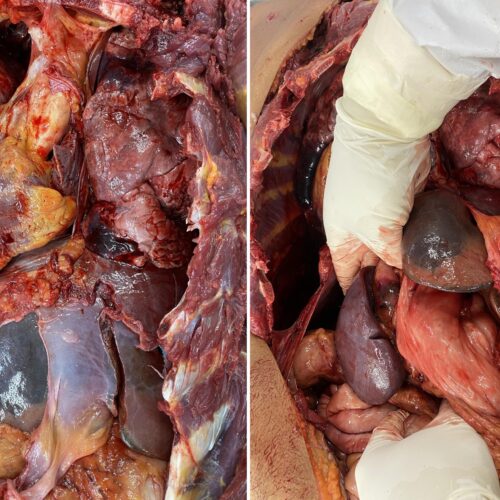
A investigação médico-legal atual tem cada vez mais ao seu dispor técnicas de exames de imagem que visam auxiliar o diagnóstico da causa de morte e mecanismos fisiopatológicos determinantes da mesma. Contudo, a dúvida levantada pela utilização desses métodos é se estes poderiam vir a ser substitutos da necrópsia convencional, ou se apenas têm capacidade de ser implementados como adjuntos da mesma. Neste trabalho, tentou-se focar os pontos a favor e contra de uma das técnicas utilizadas, modernamente, aparelho de Raios X, e fazer uma análise comparativa entre este método, no caso de feridas transfixantes por ação pérfuro contundente decorrente de projétil de arma de fogo (PAF), na região craniana, identificando2 se as estruturas lesionadas, assim como analisar o benefício de menor invasibilidade do corpo humano. ABSTRACT The current medico-legal investigation has more and more at its disposal imaging exam techniques that aim to help diagnose the cause of death and its underlying pathophysiological mechanisms. However, the question raised by the use of these methods is whether they could come to be a substitute for conventional necropsy, or whether they are only capable of being implemented as an adjunct to it. In this work, an attempt was made to focus on the points in favor and against of one of the techniques used today, the X-Ray apparatus, and to make a comparative analysis between this method, in the case of transfixing wounds by blunt perforation action resulting from a projectile of a weapon. fire (PWF), in the skull region, identifying the injured structures, as well as analyzing the benefit of less invasiveness to the human body.
Abstract
The current medico-legal investigation has more and more at its disposal imaging exam techniques that aim to help diagnose the cause of death and its underlying pathophysiological mechanisms. However, the question raised by the use of these methods is whether they could come to be a substitute for conventional necropsy, or whether they are only capable of being implemented as an adjunct to it. In this work, an attempt was made to focus on the points in favor and against of one of the techniques used today, the X-Ray apparatus, and to make a comparative analysis between this method, in the case of transfixing wounds by blunt perforation action resulting from a projectile of a weapon. fire (PWF), in the skull region, identifying the injured structures, as well as analyzing the benefit of less invasiveness to the human body.
References
1. https://amb.org.br/wpcontent/uploads/2020/03/Recomenda%C3%A7%C3%B5es-Corona-VirusABMLPM.pdf
2. https://amb.org.br/wpcontent/uploads/2020/03/Recomenda%C3%A7%C3%B5es-Corona-VirusABMLPM.pdf
3. https://epos.myesr.org/poster/esr/seram2012/S-1490/Objetivos#poster
4. http://reginaldofranklin.com.br/sobre-a-virtopsia/
5. https://epos.myesr.org/poster/esr/seram2012/S-1490/Objetivos#poster
6. file:///C:/Users/Usuario/Downloads/229841%20(1).pdf
7. Bolliger, S. A., & Thali, M. J. (2015). Imaging and virtual autopsy: looking back and forward. Philosophical Transactions of the Royal Society of London. Series B, Biological Sciences, 370(1674). https://doi.org/10.1098/rstb.2014.0253
8. Honigsbaum, M. (2013). Virtual autopsy: does it spell the end of the scalpel? Retrieved February 23, 2013, https://www.theguardian.com/science/2013/feb/23/virtualautopsy-virtopsyforensic-science from
9. ASO, J. et al . Virtopsia: Aplicaciones de un nuevo método de inspección corporal no invasiva en ciencias forenses. Cuad. med. forense [online]. n.40, p. 95-106, 2005.
10. Henriques, A. (2013). Conhece a virtopsy? É uma autopsia virtual que revoluciona os exames pos morte. Retrieved July 2, 2013, from http://ptjornal.com/conhece-avirtopsy-e-uma-autopsia-virtual-que-revolucionaos-exames-pos-morte-17246
11. Mohammed, M., & Kharoshah, M. A. (2014). Autopsy in Islam and current practice in Arab Muslim countries. Journal of Forensic and Legal Medicine. https://doi.org/10.1016/j.jflm.2014.02.005 1https://www.aurum.com.br/blog/direito-e-tecnologia/