Artigo Original
Internship in a Medical Examiner's Office in the Identification of Injuries by Means of Action: Contributions to Medical Education
Como citar: Dias MF, Oliveira MCD. Internship in a Medical Examiner's Office in the Identification of Injuries by Means of Action: Contributions to Medical Education. Persp Med Legal Pericia Med. Vol. 11, 2026; 260749.
https://dx.doi.org/10.47005/260749
Recebido em 07/05/2026
Aceito em 21/07/2026
The authors report no conflict of interest.
Internship in a Medical Examiner's Office in the Identification of Injuries by Means of Action: Contributions to Medical Education
Resumo
INTRODUÇÃO: A medicina legal possui relevante contribuição para a formação médica, especialmente na compreensão dos mecanismos de trauma e identificação das lesões corporais, embora esses conteúdos frequentemente sejam pouco explorados na graduação. MATERIAL E MÉTODO: Trata-se de um relato de experiência elaborado a partir de estágio extracurricular realizado em Instituto Médico Legal no estado do Pará, iniciado em agosto de 2025. Foram acompanhadas atividades relacionadas a exames de corpo de delito, necropsias e discussões técnico-científicas em diferentes áreas da medicina legal. RESULTADOS: O estágio possibilitou acompanhamento da rotina médico-pericial, incluindo identificação de lesões por meios da ação, como lesões contusas, cortantes, perfurocortantes e corto-contusas. Observou-se predominância de lesões contusas nos exames de lesão corporal, além de contato com áreas como traumatologia, tanatologia, sexologia e asfixiologia forense, especialmente em casos de enforcamento. DISCUSSÃO: A vivência prática favoreceu integração entre teoria e prática, contribuindo para o desenvolvimento do raciocínio observacional, da interpretação médico-legal das lesões corporais e da compreensão da interface entre medicina e justiça. Além disso, evidenciou a importância da inserção prática da medicina legal durante a graduação médica. CONCLUSÃO: O estágio em Instituto Médico Legal contribuiu para o desenvolvimento técnico, crítico e observacional do estudante de medicina, reforçando a relevância da medicina legal na formação médica.
Palavras Chave: Medicina Legal; Educação Médica; Traumatologia; Estágio Médico
Abstract
INTRODUCTION: Forensic medicine plays an important role in medical education, especially in understanding trauma mechanisms and identifying bodily injuries, although these topics are often insufficiently addressed during undergraduate training. MATERIALS AND METHODS: This is an experience report based on an extracurricular internship at a Medical Examiner’s Office in the state of Pará, Brazil, beginning in August 2025. Activities involving forensic examinations, autopsies, and technical discussions in different areas of forensic medicine were observed. RESULTS: The internship allowed observation of the medico-legal routine, including identification of injuries by means of action, such as blunt, sharp, perforating, and sharp-blunt injuries. Blunt injuries were predominant in bodily injury examinations, in addition to exposure to forensic traumatology, thanatology, forensic sexology, and forensic asphyxiology, especially in hanging cases. DISCUSSION: The practical experience promoted integration between theory and practice, contributing to the development of observational reasoning, medico-legal interpretation of injuries, and understanding of the relationship between medicine and justice. It also highlighted the importance of practical forensic medicine experiences during medical training. CONCLUSION: The internship at a Medical Examiner’s Office contributed to the technical, critical, and observational development of medical students, reinforcing the relevance of forensic medicine in medical education.
Keywords (MeSH): Forensic Medicine; Education, Medical; Traumatology; Internship and Residency
1. INTRODUCTION
Contemporary medical education requires the development of competencies that go beyond traditional clinical care, also encompassing an understanding of the ethical, legal, and social aspects involved in professional practice. In this context, forensic medicine stands out as an important area at the interface between health sciences and the justice system, contributing to the technical-scientific interpretation of situations related to violence, trauma, and deaths from external causes (1).
Forensic medical practice holds significant relevance both in the expert examination sphere and in everyday clinical practice, since the adequate recognition of bodily injuries, trauma mechanisms, and means of infliction can assist in diagnostic management, appropriate medical record-keeping, and the production of technical evidence. Among the fundamental knowledge areas in the field, the identification of injuries according to the means of the wounding agent stands out, including contusive, cutting, piercing-cutting, cut-contusive, and piercing-contusive injuries, whose analysis allows understanding the dynamics of traumatic events and their possible legal repercussions (2).
Despite the importance of these contents for medical practice, it is observed that the teaching of forensic medicine in undergraduate courses frequently occurs in a reduced and predominantly theoretical manner, and is often disconnected from forensic practice (3). Such limitations may hinder the development of forensic medical reasoning and the student’s critical capacity when faced with situations involving interpersonal violence, accidents, bodily injury examinations, and deaths from external causes — topics frequently present in the reality of health services.
In this scenario, extracurricular experiences at Legal Medical Institutes (IMLs) are configured as relevant tools for complementing academic training, enabling students to have direct contact with the forensic routine and with the practical application of knowledge addressed in the classroom. Experiences in these environments favor the integration of theory and practice, allowing greater understanding of the identification and interpretation of bodily injuries, in addition to the improvement of technical observation and adequate description of forensic findings.
Beyond technical aspects, an internship in forensic medicine also provides important reflections on professional ethics, the humanization of victim and family management, and the social relevance of forensic work in elucidating events related to violence. The student’s insertion into real practice scenarios contributes to the strengthening of critical and humanistic training, broadening their perception of the physician’s role in the production of technical-scientific knowledge aimed at collective interest and the guarantee of rights (4).
Additionally, contact with forensic practice enables greater familiarity with terminologies and classifications that are frequently underexplored during undergraduate studies, especially those related to forensic traumatology. Understanding the different types of injuries and their production mechanisms becomes relevant not only for the practice of forensic medicine, but also for clinical and surgical specialties that deal directly with victims of trauma and violence.
Thus, considering the importance of forensic medicine in medical training and the limitation frequently observed in practical teaching of the field during undergraduate education, it becomes relevant to report academic experiences developed at Legal Medical Institutes, especially with regard to the identification of injuries by means of action and their contributions to the technical, scientific, and critical development of medical students.
2. MATERIAL AND METHOD
This is a descriptive study, of the experience report type, elaborated from the academic experience of an extracurricular internship carried out at a Legal Medical Institute (IML) located in the state of Pará, Brazil, beginning in August 2025.
The experience took place during the accompaniment of activities carried out in the forensic sector, involving observation of the forensic-medical routine related to the analysis of bodily injuries and trauma mechanisms. Activities included technical accompaniment of forensic evaluations, observation of the identification of injuries by means of action — such as contusive, cutting, piercing-cutting, and cut-contusive injuries — and discussion of findings under professional supervision.
The experience enabled the integration of theoretical content addressed in medical undergraduate education with its practical application in the forensic context, allowing the improvement of observational, descriptive, and interpretive capacity regarding bodily injuries. Subsequently, theoretical references previously studied in the field of forensic medicine and forensic traumatology were analyzed, with the purpose of scientifically grounding the experiences observed during the internship and supporting the discussion of the importance of forensic medicine internships for medical training.
The information described in this study was obtained through direct observation of the activities developed during the internship and recorded in a descriptive manner, prioritizing aspects related to the contribution of the experience to medical training. No identifiable data of individuals, images, medical records, or any confidential information were used, fully preserving the ethical principles of confidentiality.
As this is an experience report based exclusively on the academic experience of the authors, without the use of identifiable data, intervention in human beings, or access to confidential information, the present study was exempt from appraisal by a Research Ethics Committee, as provided for in Resolution No. 510/2016 of the National Health Council.
3. RESULTS
The experience developed during the internship at the Legal Medical Institute provided broad experience of the forensic-medical routine, allowing direct accompaniment of the activities performed by forensic physicians and other professionals involved in the service. The internship took place in a supervised and educational manner, enabling continuous contact with different demands related to forensic medicine and forensic traumatology, significantly contributing to the expansion of theoretical-practical knowledge during medical training.
The functioning of the internship involved accompaniment of forensic activities carried out in the different sectors of the Legal Medical Institute, including bodily injury examinations of living individuals, evaluations of bodily injuries, accompaniment of necropsy examinations, and technical-scientific discussions regarding the forensic findings observed in the service’s routine. The experience enabled the academic student to understand not only the technical aspects involved in the forensic physician’s practice, but also the organizational dynamics and the importance of forensic work within the justice system.
During the accompaniments, it was possible to observe the performance of forensic examinations on victims of physical assault, accidents, and other situations involving bodily trauma, allowing greater familiarity with the procedures related to the examination of bodily injury in living individuals. In these cases, forensic physicians performed detailed analysis of injury characteristics, considering aspects such as anatomical location, extent, coloration, depth, shape, and possible causative instrument, in addition to the preparation of the respective forensic reports.
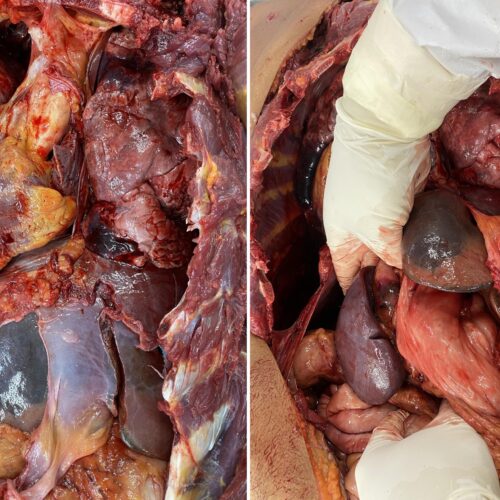
In the context of forensic necropsies, the internship allowed introductory accompaniment of cadaveric examinations related to violent and suspicious deaths, providing contact with fundamental concepts of forensic thanatology. Observation of the necropsy routine allowed greater understanding of the analysis of post-mortem signs, mechanisms of death, and initial interpretation of anatomical findings related to different causes of death.
The experience also provided contact with different areas of forensic medicine, including forensic traumatology, forensic thanatology, forensic sexology, and forensic asphyxiology. Within the scope of forensic traumatology, the practical study of bodily injuries according to the means of the wounding agent stood out, allowing the correlation of trauma mechanisms with the characteristics observed during forensic examinations.
Among the injuries observed during the forensic accompaniments, a predominance of contusive injuries was verified, frequently related to physical assaults, automobile accidents, falls, and interpersonal violence. Ecchymoses, hematomas, abrasions, and traumatic edema constituted the most frequently identified findings in bodily injury examinations. In addition to these, cut-contusive injuries were observed, characterized by the association between blunt and cutting action, generally produced by instruments with an edge associated with significant force.
Less frequently, cutting, piercing-cutting, and piercing-contusive injuries were also accompanied, enabling the academic student to understand the morphological differences between the types of injury and their respective production mechanisms. The practical identification of these injuries fostered greater understanding of the importance of adequate technical description in the forensic-medical context, especially in the correlation between the wounding instrument and the observed bodily findings.
In the area of forensic asphyxiology, discussions related to mechanisms of death by asphyxia were accompanied, especially in cases of hanging and its differentiation from other forms of asphyxia, such as strangulation and throttling. In these situations, it was possible to observe the analysis of external and internal signs compatible with cervical constriction, as well as discussions regarding the pathophysiological mechanisms involved in different types of mechanical asphyxia. Contact with these cases allowed greater understanding of the complexity of forensic-medical interpretation in violent deaths.
Regarding forensic sexology, the experience enabled observational contact with forensic procedures related to the investigation of sexual violence, evidencing the importance of technical, ethical, and humanized action toward victims. It was also possible to understand the relevance of adequate forensic-medical documentation in these cases, as well as the role of the forensic physician in producing technical elements that assist judicial investigation.
Beyond the technical knowledge related to different areas of forensic medicine, the internship contributed to the development of critical observation, descriptive reasoning, and interpretation of forensic findings. The integration of theory and practice fostered greater familiarity with terminologies and classifications frequently underexplored during medical undergraduate studies, especially those related to forensic traumatology and the mechanisms of production of bodily injuries.
The experience also allowed understanding of the importance of interdisciplinary action in the forensic context, involving professionals from different fields and evidencing the role of forensic medicine as an important instrument at the interface between health, science, and justice. Direct contact with the Legal Medical Institute’s routine enabled a broadened perception of the social relevance of forensic work and its contribution to the elucidation of events related to violence and deaths from external causes.
4. DISCUSSION
The experience lived during the internship at the Legal Medical Institute evidenced the relevance of forensic medicine as a complementary tool in medical training, especially in the development of competencies related to clinical observation, injury interpretation, and technical-scientific reasoning applied to the forensic context. The student’s insertion into real practice scenarios enabled greater approximation between the theoretical content addressed during undergraduate education and its practical application, fostering broader and more contextualized learning.
Despite the importance of forensic medicine for medical practice, it is observed that, in many educational institutions, content related to forensic traumatology, thanatology, and asphyxiology is approached in a limited and predominantly theoretical manner (5). In this sense, the extracurricular internship at the Legal Medical Institute proved to be an important strategy for academic complementation, allowing direct contact with situations frequently underexplored during undergraduate education, especially those related to the identification of injuries by means of action and the forensic-medical interpretation of forensic findings.
The accompaniment of bodily injury examinations in living individuals allowed greater understanding of the importance of the technical description of bodily injuries, an essential step both for the adequate preparation of the forensic report and for the production of technical evidence in the justice system. The predominance of contusive injuries observed during the internship reinforces the high frequency of this type of trauma in forensic practice, especially in situations of interpersonal violence, accidents, and falls (6). Ecchymoses, hematomas, and abrasions were recurrent findings, evidencing the relevance of knowledge of the morphological characteristics of injuries for the inference of causal mechanisms.
In addition to contusive injuries, contact with cut-contusive, cutting, piercing-cutting, and piercing-contusive injuries contributed to a better understanding of the differences between wounding instruments and their anatomical repercussions. The practical analysis of these injuries fostered the development of observational reasoning and the capacity to correlate physical findings with possible means of action, an aspect relevant not only to forensic medicine but also to clinical and surgical fields related to the care of trauma victims (7).
In the scope of forensic thanatology, the experience allowed introductory understanding of the dynamics of necropsy examinations and the importance of cadaveric analysis in investigating causes of death. Contact with cases related to forensic asphyxiology, especially hanging, enabled greater understanding of the pathophysiological mechanisms involved in deaths by mechanical asphyxia, as well as the external and internal signs observed in these contexts (8). These experiences contributed to broadening understanding of the complexity of forensic practice and the need for judicious interpretation of forensic-medical findings.
The experience in forensic sexology also evidenced the need for ethical, humanized, and technically qualified action in situations involving sexual violence. Observation of the conduct of forensic examinations allowed understanding of the importance of victim reception, the adequate documentation of findings, and the preservation of evidence, reinforcing the role of the forensic physician in providing technical assistance to the judicial system (9).Another relevant aspect observed during the internship was the contribution of forensic practice to the strengthening of the medical student’s critical training. Contact with situations related to interpersonal violence, violent deaths, and social vulnerabilities fostered reflections on the social impact of these grievances and the importance of the medical professional in the production of technical-scientific knowledge aimed at the guarantee of rights and the promotion of justice (10).
Furthermore, practical experience allowed greater familiarity with terminologies and classifications frequently underexplored in medical undergraduate studies, contributing to the development of descriptive and observational skills important for different areas of medicine. The recognition of injuries by means of action proved relevant not only in the forensic context, but also in everyday clinical practice, especially in emergency, urgent care, and trauma services.
However, certain limitations must be considered. As this was an observational extracurricular internship, the experience was conditioned to the forensic demand of the service, which limited uniform contact with all types of injuries and forensic-medical situations. Furthermore, the limited duration of the experience may restrict deeper exploration of specific areas of forensic medicine (11). Another limitation refers to the fact that the study is based on academic perceptions arising from practical experience, not allowing generalizations regarding medical training in other institutional contexts.
Despite these limitations, the internship at the Legal Medical Institute demonstrated an important contribution to medical training, especially in the development of observational reasoning, the interpretation of bodily injuries, and the understanding of the interface between medicine, science, and justice. The experience reinforces the relevance of the practical insertion of students in forensic-medical scenarios as a complementary teaching strategy, contributing to broader technical, ethical, and critical training.
5. CONCLUSION
The internship at the Legal Medical Institute demonstrated a relevant contribution to medical training by providing practical experience in different areas of forensic medicine, especially in the identification of injuries by means of action and in the understanding of forensic practice. The experience enabled integration between theory and practice, fostering the development of observational capacity, descriptive reasoning, and technical-scientific interpretation of bodily injuries.
The accompaniment of bodily injury examinations, necropsies, and discussions related to traumatology, thanatology, asphyxiology, and forensic sexology allowed greater familiarity with content frequently underexplored during medical undergraduate studies. Furthermore, the experience contributed to broadening understanding of the interface between health, ethics, and justice, evidencing the social relevance of forensic medicine in the context of professional practice.
The predominance of contusive injuries observed during the forensic accompaniments reinforced the importance of knowledge of injury classifications and trauma mechanisms for the adequate forensic-medical interpretation of findings. Contact with different types of injuries fostered the consolidation of theoretical learning and the practical understanding of the means of the wounding agent.
In this way, the experience evidenced that internships at Legal Medical Institutes constitute important complementary tools in the medical training process, contributing to the technical, critical, and humanistic strengthening of the student. Furthermore, the need for greater valorization and practical insertion of forensic medicine content during undergraduate education is reinforced, considering its relevance for medical practice and for the understanding of grievances related to violence and external causes.
References
1. Romeiro Ramires LO, Meneguette C, Praseres Nunes P. Medicina legal: um pilar essencial à interseção entre o sistema de saúde e o Judiciário – uma revisão de literatura. Ulakes J Med. 2023;3(3). doi:10.56084/ulakesjmed.v3i3.909.
2. Eze UO, Ojifinni KA. Trauma forensics in blunt and sharp force injuries. J West Afr Coll Surg. 2022;12(4):94-101. doi:10.4103/jwas.jwas_190_22.
3. Miziara CSMG, Dantas RAA, Souza JPN, Miziara ID. Ensino de medicina legal e perícia médica nas escolas médicas. Cad Pedag. 2025;22(9):e18241. doi:10.54033/cadpedv22n9-228.
4. Paula FF, Golino TC, Hojaij FC. O valor do estágio observacional clínico no início da graduação médica. Cad Pedag. 2025;22(6):e15880. doi:10.54033/cadpedv22n6-274.
5. Borba DNM, Soares FJP. Teaching of forensic medicine and medical expertise based on skills: a new curriculum proposal. New Trends Qual Res. 2020;2:210-223. doi:10.36367/ntqr.2.2020.210-223.
6. Zimmerman SF, Fraga AMA, Morcillo AM, Silveira NYJ, Antonio MARGM. Acidentes com crianças e adolescentes, segundo o Inquérito Sentinela. Rev Ciênc Méd. 2019;27(3):115-124. doi:10.24220/2318-0897v27n3a4315.
7. Sarquis LM, Brunet-Schultze AC, Gazola BB, Collaço IA, Aguiar AJD, Fontes H. Epidemiological analysis of cardiac trauma victims at a referral trauma hospital: a 5-year case series. Rev Col Bras Cir. 2022;49:e20223120. doi:10.1590/0100-6991e-20223120.
8. Tavares SLB, Freitas MMCS, Ferreira ACS, Silva LS, Moitinho PBCC, Esteves AJ. Asfixiologia forense: a investigação criminal alicerçada na medicina legal. Rev DCS. 2021;18(66).
9. Drezett J, Vertamatti MAF, Barbosa RM, Taribagil C, Nassif VC. Influência do exame médico-legal na responsabilização do autor da violência sexual contra adolescentes. Rev Bras Crescimento Desenvolv Hum. 2011;21(2):189-197.
10. Silva MMB. A importância da prova pericial no processo penal e a imparcialidade do perito na investigação criminal. RECIMA21. 2024;5(12):e5125985. doi:10.47820/recima21.v5i12.5985.
11. Silva J, Nonato A. Estágio eletivo em medicina legal: relato de experiência em um serviço de verificação de óbito. Rev Foco. 2024;17:e5500. doi:10.54751/revistafoco.v17n6-150.