Relato de Caso
Investigation of Sudden Infant Death Syndrome based on necroscopic findings: A case report
Como citar: Alcântara WLD, Lima PHMN, Carvalho LED, Amaral LHO, Amaral FG, Moura MFR. Investigation of Sudden Infant Death Syndrome based on necroscopic findings: A case report. Persp Med Legal Pericia Med. Vol. 10, 2025; 250519.
https://dx.doi.org/10.47005/250519Aceito em 04/09/2025
The authors report no conflict of interest.
Investigation of Sudden Infant Death Syndrome based on necroscopic findings: A case report
Resumo
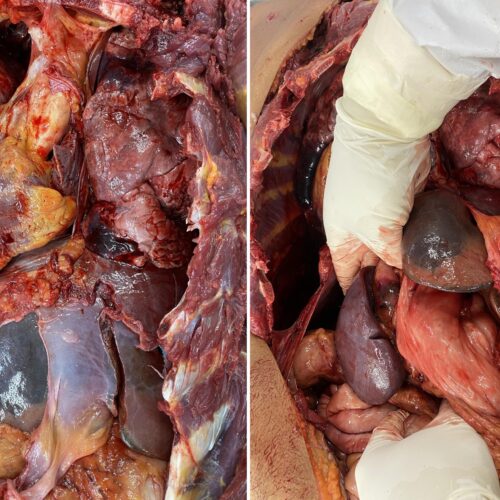
INTRODUÇÃO: A Síndrome Infantil de Defunção Súbita (SIDS) é definida por morte inesperada em crianças menores de um ano e que permanece inexplicada após investigação extensa do caso, incluindo revisão da história clínica, necropsia completa e exame do local de óbito. Este trabalho busca discutir as dificuldades inerentes a esse diagnóstico a partir de relato de caso. MATERIAIS E MÉTODOS: Realizou-se uma revisão não sistematizada da literatura disponível em bases de dados em associação ao caso de um recém-nascido necropsiado em agosto de 2019 na Delegacia Regional de Polícia Civil de Divinópolis, município de Minas Gerais. RELATO DE CASO: Recém-nascido de 13 dias de vida, sexo feminino, encontrado sem vida pela mãe na cama onde dormiam juntas. Em discussão do laudo, foram levantadas hipóteses de asfixia e SIDS. DISCUSSÃO: Alguns fatores de risco são exposição intrauterina a drogas, tabagismo materno, roupa de cama cobrindo o rosto, e compartilhamento de cama. Neste caso, a criança apresentava sinais de asfixia, como congestão vascular no encéfalo, equimoses poliviscerais e sangue fluido e escuro. Não foi identificada causa obstrutiva em vias aéreas que pudesse indicar sufocação direta, assim como a hipótese de sufocação indireta não pôde ser descartada. Os sinais evidenciados podem estar presentes na SIDS, tornando o diagnóstico final incerto. CONCLUSÃO: Trata-se de caso desafiador para o profissional, que diante de achados inespecíficos ao exame do cadáver, muitas vezes não consegue estabelecer a causa mortis. Educação de gestantes e cuidadores é importante para evitar esses óbitos.
Palavras Chave: Síndrome da Morte Súbita do Lactente, Síndrome Infantil de Defunção Súbita, Sufocação, Asfixia, Pediatria.
Abstract
INTRODUCTION: Sudden Infant Death Syndrome (SIDS) is defined by the unexpected death of children under one year old which remains unexplained after extensive investigation, including a revision of clinical history and of the location of death and complete necropsy. This work aims to discuss the difficulties inherent to this diagnosis from a case report. MATERIAL AND METHODS: A non-systematic review of the literature available in databases was performed, as well as the analysis of a case report of the necropsy of a newborn in August 2019 in a Police Department in Divinópolis, Minas Gerais, Brazil. CASE REPORT: A 13-days-old female infant was found dead by her mother on their shared bed. The report brings up the hypotheses of asphyxiation and SIDS. DISCUSSION: Some risk factors include in-utero exposure to drugs, maternal smoking, bed sheets covering the child’s face, and bed-sharing. In this case, the baby showed signs of asphyxia, such as brain vascular congestion, visceral petechiae, and dark and fluid blood. No obstructive cause was found in the victim’s airways to indicate choking, but smothering, compressive, or positional asphyxia also cannot be ruled out. The signs presented can be attributed to SIDS, making the final diagnosis uncertain. CONCLUSION: It is a challenging case for the medical professional, who, facing the non-specific findings of the autopsy, often cannot firmly establish a cause of death. The education of pregnant women and child carers is important to avoid these deaths.
Keywords (MeSH): Sudden Infant Death Syndrome, Suffocation, Asphyxia, Pediatrics.
References
1. Anderson HR, Cook DG. Passive smoking and sudden infant death syndrome: review of the epidemiological evidence. Thorax. 1997 Nov;52(11):1003-9. doi: 10.1136/thx.52.11.1003. Erratum in: Thorax 1999 Apr;54(4):365-6. PMID: 9487351; PMCID: PMC1758452.
2. Blackwell CC, Weir DM, Busuttil A. Infectious agents, the inflammatory responses of infants and SIDS. Molecular Biology Today 1995; 1 : 72 -78
3. Hoffman HJ, Hillman LS. Epidemiology of the sudden infant death syndrome: maternal, neonatal, and postneonatal risk factors. Clin Perinatol. 1992 Dec;19(4):717-37. PMID: 1464187.
4. Kim H, Pearson-Shaver AL. Sudden Infant Death Syndrome [Internet]. PubMed. Treasure Island (FL): StatPearls Publishing; 2024. Disponível em: https://www.ncbi.nlm.nih.gov/books/NBK560807
5. Kim TH, Lee H, Woo S, Lee H, Park J, Fond G et al. Prenatal and postnatal factors associated with sudden infant death syndrome: an umbrella review of meta-analyses. World J Pediatr. 2024 May;20(5):451-460. doi: 10.1007/s12519-024-00806-1. Epub 2024 Apr 29. PMID: 38684567.
6. Krous HF, Beckwith JB, Byard RW, Rognum TO, Bajanowski T, Corey T et al. Sudden infant death syndrome and unclassified sudden infant deaths: a definitional and diagnostic approach. Pediatrics. 2004 Jul;114(1):234-8. doi: 10.1542/peds.114.1.234. PMID: 15231934.
7. Mage DT, Donner M. A genetic basis for the sudden infant death syndrome sex ratio. Med Hypotheses. 1997 Feb;48(2):137-42. doi: 10.1016/s0306-9877(97)90280-2. PMID: 9076695.
8. McNamara F, Sullivan CE. Evolution of sleep-disordered breathing and sleep in infants. J Paediatr Child Health. 1998 Feb;34(1):37-43. doi: 10.1046/j.1440-1754.1998.00150.x. PMID: 9568939.
9. Nunes ML, Pinho AP, Aerts D, Sant’Anna A, Martins MP, Costa JC. Síndrome da morte súbita do lactente: aspectos clínicos de uma doença subdiagnosticada [Sudden infant death syndrome: clinical aspects of an underdiagnosed disease]. J Pediatr (Rio J). 2001 Jan-Feb;77(1):29-34. Portuguese. PMID: 14647616.
10. Park S, Han JH, Hwang J, Yon DK, Lee SW, Kim JH et al. The global burden of sudden infant death syndrome from 1990 to 2019: a systematic analysis from the Global Burden of Disease study 2019. QJM. 2022 Nov 14;115(11):735-744. doi: 10.1093/qjmed/hcac093. PMID: 35385121.
11. Peres LC. SIDS – Síndrome Infantil da Defunção Súbita. Medicina, v. 38, n. 1, p. 34–34, 30 mar. 2005.
12. Thach BT. How does prone sleeping increase prevalence of sudden infant death syndrome? Pediatr Pulmonol Suppl. 1997;16:115-6. doi: 10.1002/ppul.1950230864. PMID: 9443232.